For many OEMs, spare parts should be one of the most predictable sources of revenue - some sees that revenue as high as 58%.
Installed equipment creates years of demand for replacement components, maintenance kits and service parts. In theory, this should make the aftermarket one of the most stable and profitable parts of the business.
Yet many manufacturers struggle to fully capture that opportunity.
Customers often find it difficult to identify the correct part. Dealers email service teams for confirmation. Engineers are pulled into support requests to interpret diagrams or verify part numbers.
These issues may appear operational.
But over time, they become a hidden revenue leak that quietly limits aftermarket growth.
Why Parts Identification Is Still a Major Challenge
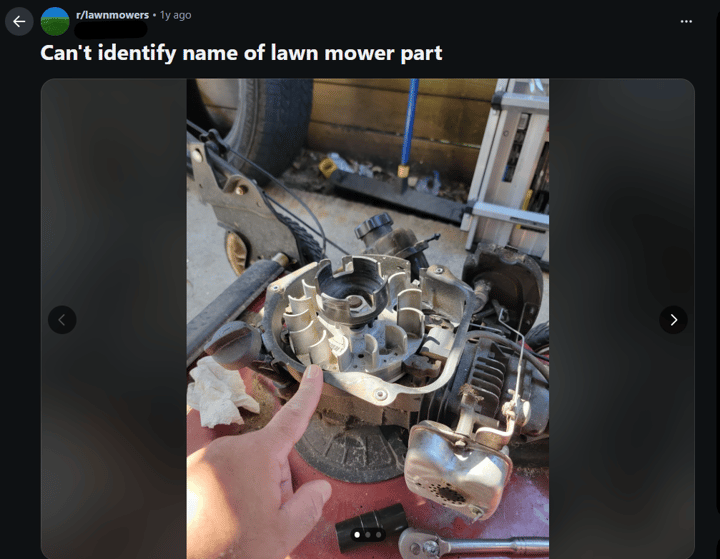
Image: Reddit
Despite the growing importance of aftermarket revenue, many OEMs still rely on parts identification systems that were designed decades ago.
This challenge is widely recognised across the industry.
Research shows that 82% of OEMs report major frustrations with their parts catalogs or work instructions, often because the documentation is unclear, overly complex or difficult to update.
Parts information is often delivered through static PDFs or complex diagrams that require customers to interpret technical drawings.
For experienced technicians, this can already be difficult.
For dealers or operators with limited product familiarity, it becomes even harder.
As a result, parts identification often turns into a manual support process.
Customers send screenshots asking which component they need. Dealers request clarification on part numbers. Service teams search through documentation to confirm the correct item.
When parts documentation is difficult to navigate, identifying the right component becomes slower and more error-prone.
And that friction affects every stage of the aftermarket journey.
The Cost of Getting Parts Identification Wrong
When customers struggle to identify the correct part, mistakes are inevitable.
Incorrect orders are a persistent challenge for many manufacturers.
Research shows that 71% of OEMs experience at least one incorrect parts order in every 50 orders, while 22% report error rates closer to one in every 20 orders.
Each error triggers a chain reaction of operational work.
Aftersales teams must investigate the issue, process returns or replacements, coordinate shipping and communicate with the customer.
.png?width=720&height=221&name=Hidden%20rev%20leak%20Poor%20parts%20identification-%20stats%20(1).png)
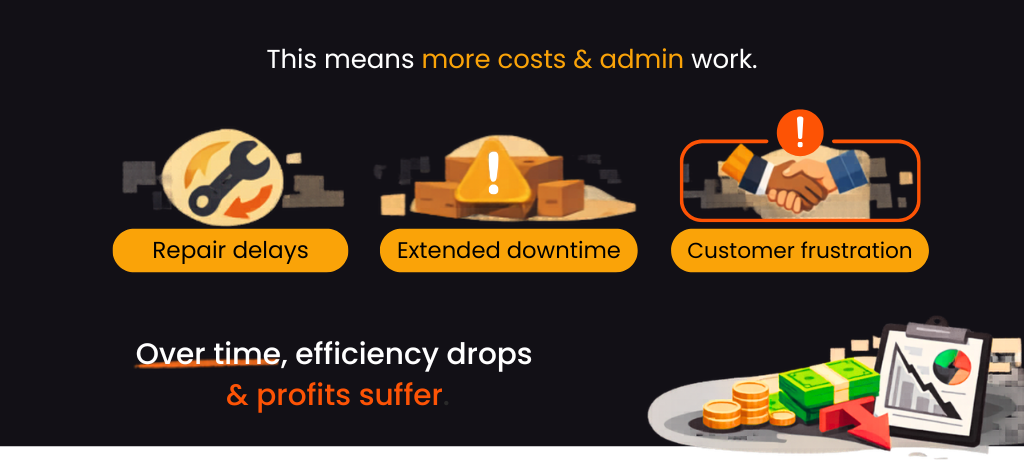
These activities create additional costs and administrative workload. They also slow down the service process for the customer.
Incorrect parts can delay repairs, extend equipment downtime and reduce confidence in the OEM’s support capabilities.
Over time, this operational drag reduces both efficiency and profitability.
Why Poor Parts Identification Leads to Lost Revenue
The impact of poor parts identification goes beyond operational inefficiency.
It also affects where customers choose to buy their parts from.
When identifying and ordering parts becomes difficult, customers often look for alternative suppliers who can provide a faster or simpler purchasing experience.
Research suggests this shift is already happening.
Only 35% of OEMs believe customers purchase most replacement parts directly from the manufacturer, indicating that a large share of aftermarket revenue flows to third-party suppliers.
Once customers start sourcing parts elsewhere, it becomes difficult for OEMs to recover those sales.
The installed base may remain the same.
But the OEM captures a smaller share of the aftermarket revenue attached to it.
How Digital Tools Improve Parts Identification
Many manufacturers are now rethinking how parts identification works across the aftermarket.
Instead of relying on static documentation, modern OEMs are adopting digital parts catalogs and interactive product platforms that make it easier for users to locate the correct component.
These systems allow customers and dealers to:
- visually explore product assemblies
- search parts quickly
- access up-to-date documentation
- identify components more accurately
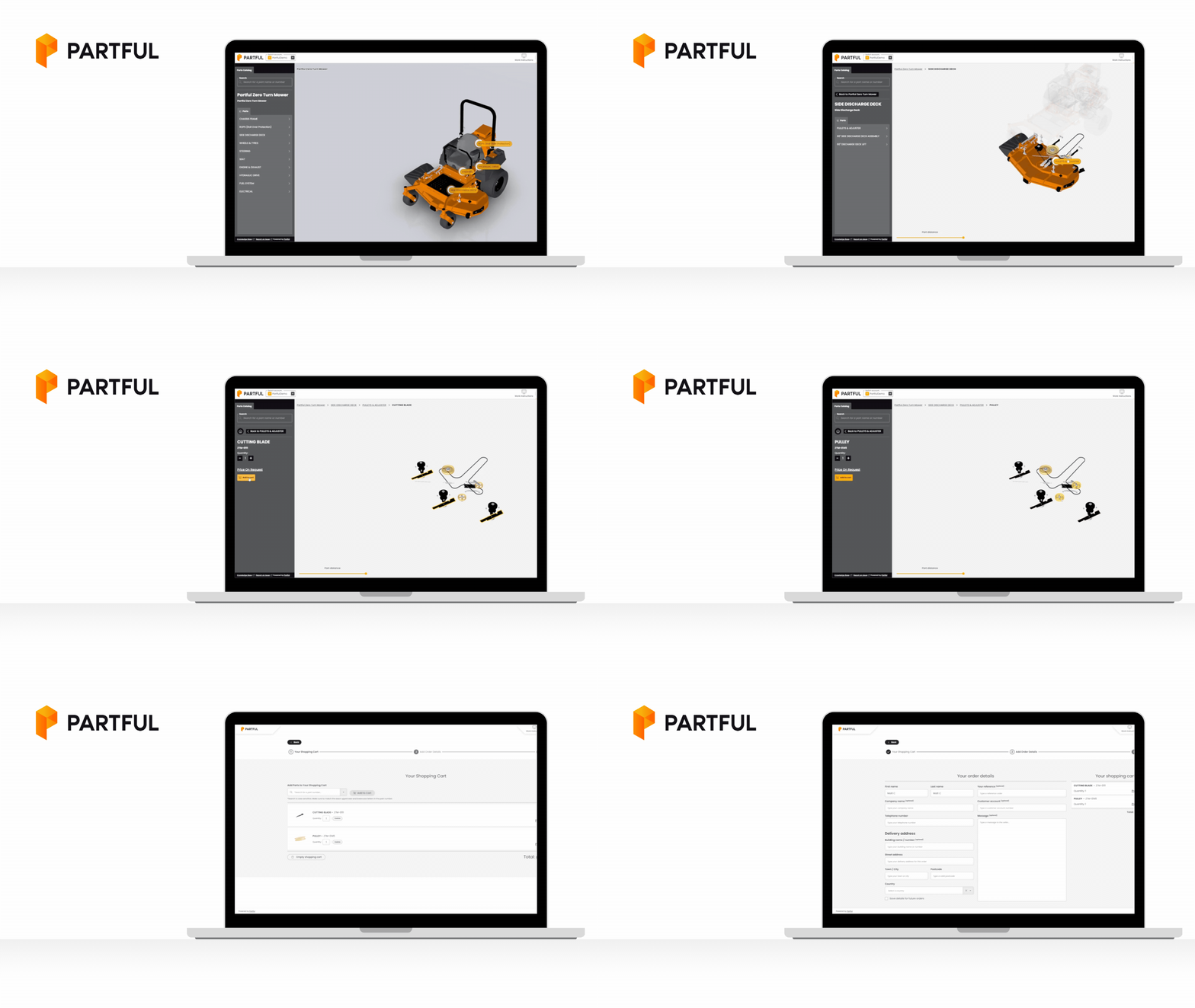
By connecting engineering data directly to the parts catalog, manufacturers can also update documentation immediately.
This reduces the manual workload associated with publishing and maintaining parts resources.
More importantly, it allows customers to identify parts independently without relying on service teams.
How OEMs Can Turn Parts Identification Into a Revenue Driver
For many OEMs, improving parts identification does not require creating entirely new systems.
Most manufacturers already possess the engineering data required to support modern aftermarket experiences.
The challenge is transforming that data into tools that customers can actually use.
This is where digital parts platforms are beginning to play a larger role.
Solutions such as Partful’s 3D Electronic Parts Catalog (EPC) transform CAD and BOM data into interactive 3D product views that make parts identification significantly easier.
Users can visually navigate assemblies, isolate individual components and confirm part numbers quickly.
This improves accuracy while reducing the need for manual support.
When parts identification becomes faster and clearer, several things happen:
- Ordering errors decrease
- Service teams receive fewer support requests
- Customers order parts with greater confidence
Most importantly, OEMs capture more of the aftermarket revenue that already exists within their installed base.
Because in many cases, the demand for spare parts is already there.
The real challenge is simply making it easier for customers to find the right part.
 Partful