Sustainability in manufacturing is often framed through carbon targets, energy efficiency, and supply chain optimisation.
Those things matter. But they don’t tell the whole story.
Industry 5.0 broadens the sustainability conversation by linking it directly to how work is executed day to day. It recognises that sustainability is not only about what materials you use or how energy-efficient your facilities are, but about how consistently and correctly work is done.
In other words:
Getting work right first time
is a sustainability strategy.
Why Industry 5.0 connects execution quality to sustainability
Industry 5.0 is built on three principles:
- Human-centricity
- Resilience
- Sustainability
What’s often missed is how tightly these are connected.
When work is unclear, inconsistent, or overly dependent on individual experience:
-
Errors increase
-
Rework becomes normalised
-
Materials are wasted
-
Time and energy are consumed fixing avoidable mistakes

Industry 5.0 reframes sustainability as an outcome of better systems supporting people, not just better reporting.
High-quality execution reduces waste automatically. Sustainability goes beyond carbon metrics - whilst carbon reporting is important, it’s only one dimension of sustainability.
Many OEMs overlook the environmental and financial cost of:
-
Scrap parts
-
Reworked assemblies
-
Incorrect servicing
-
Returned components
-
Materials wasted during training
This is particularly acute in industries using:
-
Expensive materials like leather, gold and suede
-
Composite or non-recyclable materials
-
Precision-engineered components
Every mistake carries a double cost of financial loss and environmental impact.
And much of this waste is not caused by negligence, but by unclear instructions, inconsistent training, and reliance on tribal knowledge.
The role of clarity in reducing waste
One of the most effective ways to reduce waste is also one of the simplest: make work clearer.
When teams understand:
-
What needs to be done
-
In what order
-
To what standard
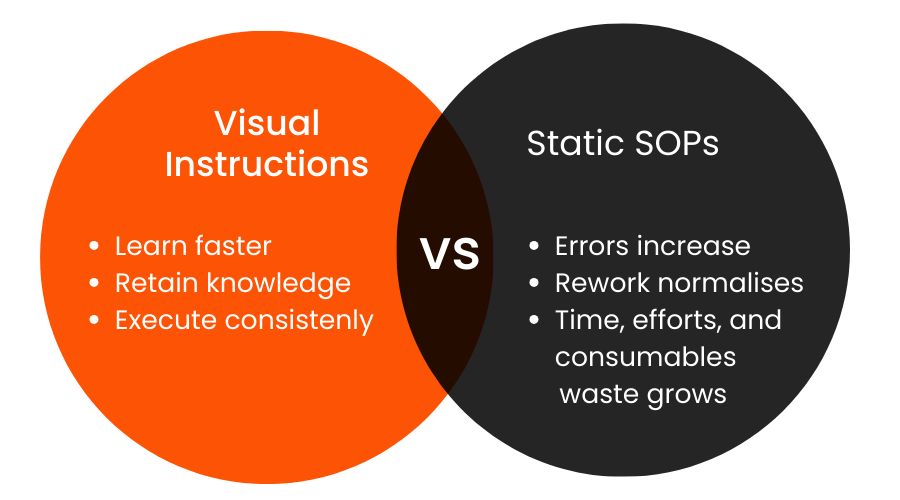
They make fewer mistakes.
Industry 5.0 prioritises clarity by supporting learning in the flow of work. Instead of expecting people to memorise processes or interpret dense documentation, guidance is embedded directly into the task.
Visual, step-by-step work instructions help people:
- Learn faster
- Retain knowledge better
- Execute consistently under pressure
This creates a form of sustainability that compounds over time: less rework, less scrap, and fewer errors as teams scale.
Small improvements, compounding impact
The sustainability gains from better execution rarely come from a single dramatic change. They come from many small improvements adding up.
For example, with a Tier 2 automotive OEM, we observed the following outcomes after implementing visual 3D work instructions using Partful:
- Training time cut by over 50%: New operators onboarded in just three weeks, rather than several months
- Reduced labour costs of £80,000+: Faster ramp-up and fewer execution errors
- Reduced material costs of £128,000+: Savings driven by lower scrap rates and less material wasted during training
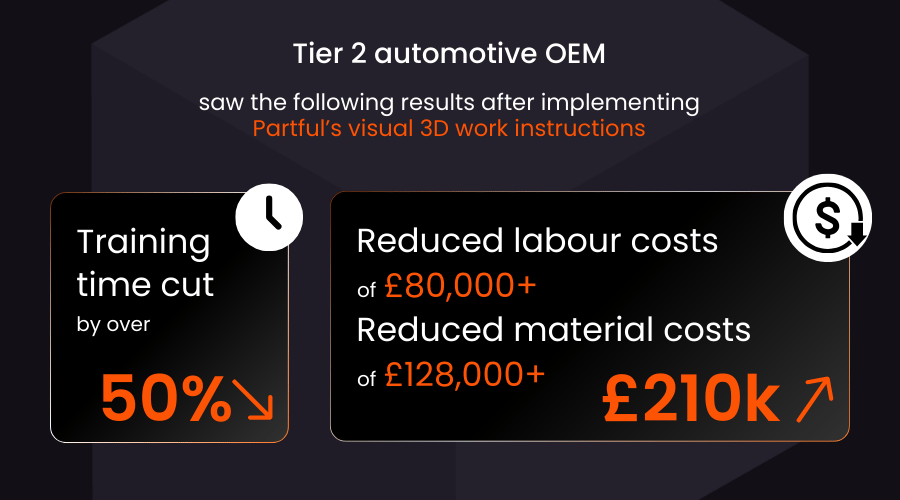
That’s £210,000 saved a year. None of these improvements was achieved by working harder. They came from working more clearly - and smarter.
This is sustainability as a by-product of better execution.
Why this matters now for OEMs
As OEMs face increasing pressure to:
- Improve sustainability credentials
- Reduce operational costs
- Address skills shortages
- Scale without increasing waste
Industry 5.0 offers a practical path forward. Rather than treating sustainability as a separate initiative, it becomes embedded in everyday operations through:
- Better guidance
- Faster learning
- More consistent execution
This approach aligns environmental responsibility with business performance rather than forcing trade-offs between the two.
What OEMs should do next?
Getting work right the first time doesn’t require a radical overnight change.
It starts with asking:
- Where do mistakes, rework, or scrap occur most often?
- How much of that is caused by unclear or outdated work instructions?
- Are people supported while doing the work, or only trained beforehand?
.png?width=631&height=351&name=blog%203%20asking%20(1).png)
Industry 5.0 encourages OEMs to see sustainability not as a reporting exercise, but as an execution challenge.
When people are supported with clearer, more usable information, better outcomes follow naturally. For the workforce. For the business. And for the environment.
 Partful